
Midyear State Minimum Wage Rate Updates:
July 1, 2026
By Dana Holle, GovDocs Counsel and Manager Employment Law and Compliance
Published June 4, 2025

By Dana Holle, GovDocs Counsel and Manager Employment Law and Compliance
Published June 4, 2025
📍 The right rate depends on where within a state an employee works, not just the state itself.
⚠️ State compliance alone is not enough when local wage rate may go further.
As temperatures rise this summer, so will minimum wage rates in several jurisdictions across the United States. Although most minimum wage changes take effect at the beginning of the year, some states and localities follow a different schedule. On July 1, 2026, employers in Alaska, Oregon, and Washington, D.C., will be required to implement new minimum wage rates.
Alaska’s minimum wage will increase on July 1, 2026, as a result of a previous ballot resolution that was passed a few years ago.
The minimum wage will increase from $13.00 per hour to $14.00 per hour starting on July 1st, 2026.
Alaska prohibits employers from taking a tipped credit, so there is no separate tipped employee wage.
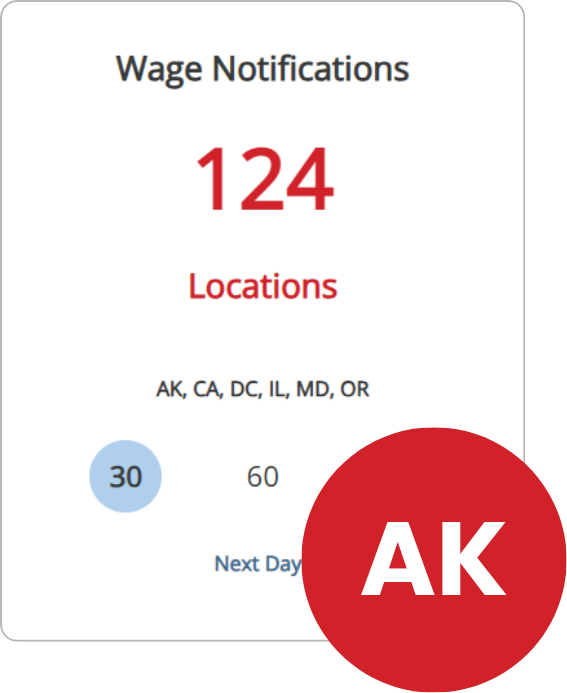
Alaska’s July 1 minimum wage increase may seem straight forward, but even a single-rate change can create ripple effects across your organization. Employers should review wage rates, update employee communications, evaluate payroll systems, and ensure any required labor law postings reflect the new requirements.
GovDocs monitors minimum wage changes across jurisdictions and keeps employers informed of upcoming requirements through centralized compliance tracking down to the location level.
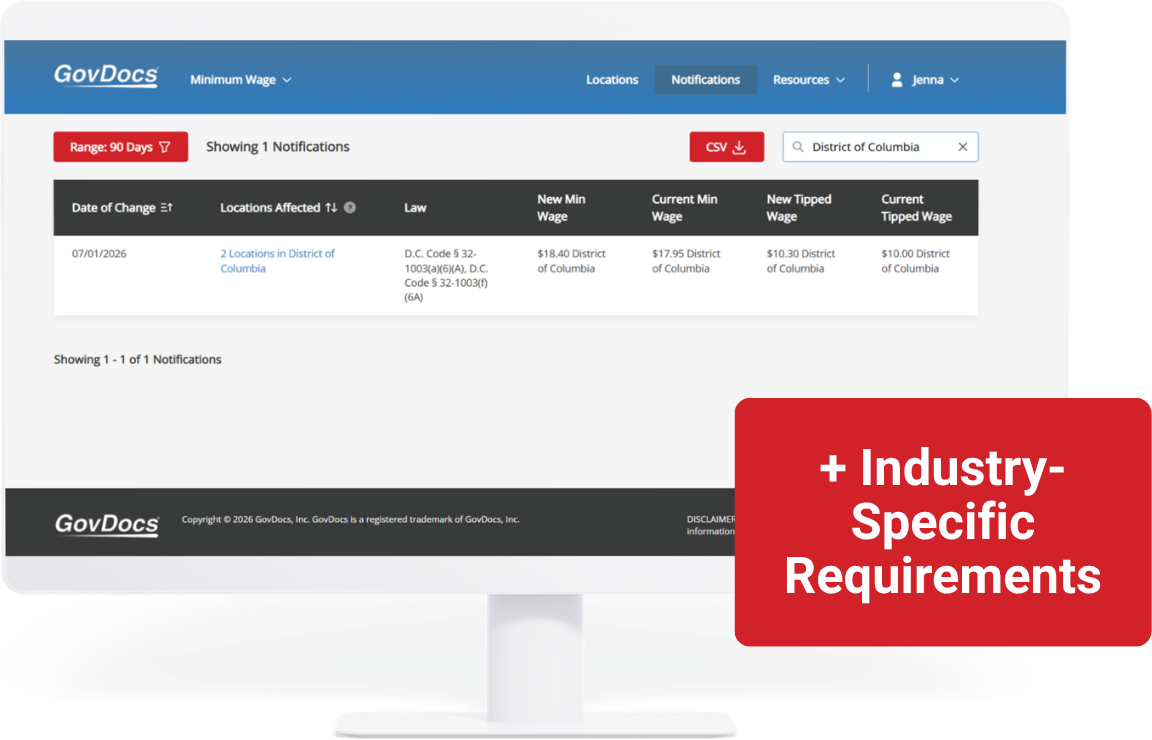
The District of Columbia will also increase its minimum wage on July 1, 2026, as follows:
Washington D.C. voters approved a ballot measure, known as Initiative 82, back in 2022, which gradually increases the tipped employee wage until it’s equal to the standard wage on July 1, 2027. However, in July 2025, the city council passed an amendment to Initiative 82 that extends the period through 2034 and caps the tip credit at 75% of the regular minimum wage.
Washington, D.C.’s minimum wage landscape continues to evolve, and employers must not only account for minimum wage increases but also understand how tipped wage requirements impact scheduling, payroll, budgeting, and compliance planning.
For organizations with restaurant, hospitality, or service industry employees, staying current on tipped wage requirements can be particularly challenging as regulations continue to change.
GovDocs Compliance and Research team monitors ongoing minimum wage and tipped wage developments to help employers understand regulatory changes and identify which locations may be affected before new requirements take effect.
Oregon has a unique, three-tiered system of minimum wage rates that updates on July 1 of each year. The applicable minimum wage tier depends on the employee’s workplace location within the state.
Effective July 1, 2026, the wages in the three-tiered system of Oregon are as follows:
Portland Metro’s minimum wage applies to workers within the “urban growth boundary” in the state, which includes parts of Clackamas, Multnomah, and Washington counties.
The standard minimum wage applies to workers in Benton, Clatsop, Columbia, Deschutes, Hood River, Jackson, Josephine, Lane, Lincoln, Linn, Marion, Polk, Tillamook, Wasco, and Yamhill counties as well as parts of Clackamas, Multnomah, and Washington that are outside the urban growth boundary described above.
The non-urban minimum wage applies to workers in Baker, Coos, Crook, Curry, Douglas, Gilliam, Grant, Harney, Jefferson, Klamath, Lake, Malheur, Morrow, Sherman, Umatilla, Union, Wallowa, and Wheeler Counties.
Like Alaska, Oregon also prohibits taking a tip credit, so the state has no tipped employee wage.

Oregon’s three-tier minimum wage structure creates an added layer of complexity for employers. Organizations with locations across multiple counties may have employees subject to different wage requirements, making accurate location-based compliance critical.
As wage rates continue to rise, employers should ensure that their workplace locations are properly assigned the right jurisdiction and that their payroll system reflects the correct rate based on the employee’s work location.
GovDocs helps organizations navigate jurisdiction-specific wage assignments with LocationCheck technology by assigning wages based on latitude and longitude, not city names and zip codes.
As July 1st approaches, employers with locations in the above states should review location jurisdictions, employee wages, communication workflows, and payroll operations to ensure compliance with the new minimum wage and tipped wage requirements.
Check if GovDocs is the right trusted partner for your Minimum Wage Solution.
GovDocs continuously monitors federal, state, and local regulatory developments and provides HR, Compliance, Compensation, Total Rewards, and Legal teams with visibility into upcoming minimum wage changes that directly impact their workforce.
Yes. GovDocs uses location-based technology power to help employers understand which worksites may be affected by changing wage requirements.
No. GovDocs supports compliance monitoring across a broad range of employment law requirements including exempt salary thresholds, tipped wages, pay transparency, indexing rates, overtime, recordkeeping, and more.
There are multiple different avenues that employers can choose based on their workflow. GovDocs provides compliance updates through monthly emails, reporting tools, and centralized dashboard visibility across locations.
This Employment Law News blog is intended for market awareness only, it is not to be used for legal advice or counsel.

Who is GovDocs?
GovDocs is a leading provider of employment law compliance solutions, empowering HR professionals to navigate complex, location-specific labor law postings, minimum wage requirements, and paid leave laws. GovDocs combines innovative technology with dedicated human-touch support to deliver worry-free compliance. Customers benefit from access to a centralized system, trusted resources, and expert employment law support they need, all in one place, to simplify compliance and protect their organization from risk. Trusted by over 35% of Fortune 500 companies, GovDocs focuses on comprehensive coverage of Federal, State, City, and County laws making employment law management seamless for organizations of all sizes. Join the evolution of employment law compliance here!
The GovDocs Poster Store simplifies posting compliance for employers with less than 30 locations across all industries, offering a variety of posting products to meet your labor law compliance needs.
