1. E-Verify stops operations during a federal government shutdown.
During a federal government shutdown, E-Verify stops its operations. For employers, this means they will not be able to process new hires and verify an employee’s eligibility to work. Also, all E-Verify support shuts down. This means employers cannot view cases, change or create an account, or access any customer support.
2. The number of E-Verify participants has tripled over the past decade.
From 2011 to 2021, the number of participating employers has climbed from 293,000 to 998,000. This increase has remained relatively consistent, with the total number of E-Verify employers hitting 1,392,898 in 2025, and it will likely continue during the next decade. You can read more about this trend on the official government website.
3. E-Verify CANNOT determine the immigration status of an individual.
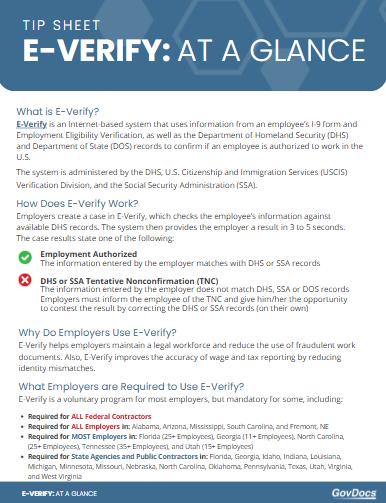
Contrary to what many believe, E-Verify does not actually verify the immigration status of an individual. The E-Verify system compares information from an individual’s I-9 form with SSA and DHS records to verify their employment eligibility to work in the United States.
4. E-Verify is not the same as the social security verification system.
E-Verify confirms the individual’s employment eligibility, while the Social Security Number Verification Service verifies an individual’s name matches a Social Security Number (SSN). It is possible for an individual to have a valid SSN but not be authorized to work in the U.S.