JUNE EDITION
Your Compliance Questions, Answered
 By Christina Everling, GovDocs Attorney
Employment Law and Compliance
June 22, 2026
Each month, GovDocs’ Employment Law & Compliance Team answers the most common employment law questions employers are facing. This edition covers new state electronic monitoring notification requirements, a roundup of Virginia’s recently passed employment laws, and an update on the federal contractor minimum wage.
Staying compliant in today’s rapidly evolving employment law landscape often raises more questions than answers. Each month, Christina Everling, GovDocs’ Attorney on the Employment Law & Compliance Team, tackles the most asked employment law compliance questions by employers across the country.
What Minimum Wage Applies to Your Cook County Business?
Cook County Minimum Wage Rate for 2026
Cook County’s minimum wage is increasing to $15.40 per hour for non-tipped workers and $9.25 for tipped workers on July 1, 2026.
Who Is Covered Under the Cook County Minimum Wage Ordinance
In October 2016, the Cook County Board of Commissioners passed the Cook County Minimum Wage Ordinance (MWO). It applies to employees who work within Cook County’s geographic boundaries for at least two hours in a two-week period for an employer that employs four or more employees or a domestic worker and maintains a business facility within Cook County or holds a Cook County business license. Covered work time includes compensated travel time within Cook County, such as deliveries, sales calls, or other business-related travel, but excludes uncompensated commuting time within the county.
Keep Informed
with GovDocs Employment Law News
Home Rule Municipalities Can Opt Out of the MWO
The MWO does not apply to employees under the age of 18, who are instead subject to state minimum wage requirements under the Illinois Minimum Wage Act. Under state law, minors must be paid at least $13.00 per hour for the first 650 hours worked in a calendar year and then $15.00 per hour thereafter.
Uniquely, home rule municipalities in Illinois – those cities with more than 25,000 residents or cities that have passed a local home rule referendum – can opt out of certain county-level ordinances, including the MWO.
Though about 80% of home rule municipalities within Cook County have opted out of the MWO requirements, only Chicago has passed its own minimum wage ordinance. The rest of the opted-out municipalities follow the Illinois state minimum wage requirements. The result is a patchwork application of state and county minimum wage laws, where neighboring jurisdictions may have different minimum wage requirements.
Why Business Location Determines the Correct Minimum Wage
Determining the correct minimum wage rate requires confirming the precise geographic location of the business, not just its mailing address or zip code. For example, a company with a location near the borders of Chicago, Cicero, and Oak Park has three potentially applicable minimum wages: Chicago’s city minimum wage, Cook County’s minimum wage, and Illinois’ state minimum wage.
Example: Oak Park, Cicero, and Chicago Minimum Wage Rates
Oak Park has not opted out of the MWO, so a business with an address located in Oak Park is subject to the Cook County minimum wage of $15.40. Meanwhile, a business location in neighboring Cicero must pay its employees at least the state minimum wage of $15.00 because Cicero has opted out of the MWO. And, of course, Chicago has its own minimum wage of $17.05 (as of July 1, 2026).
Managing Multi-Location Compliance in Cook County
For multi-location employers, particularly those with multiple locations in Cook County, manually tracking these distinctions across dozens of addresses can quickly get complicated. GovDocs uses LocationCheck™, a process of taking an organization’s physical address and assigning longitude and latitude coordinates to determine correct jurisdictional assignment, to reduce compliance risks associated with manual jurisdictional assignment.
What Does Washington’s Immigrant Worker Protection Act Require of Employers?
On March 30, 2026, Washington’s Governor signed the Immigrant Worker Protection Act (HB 2105) into law to protect immigrant workers and provide employers with clarity about their rights and obligations when federal agencies conduct Form I-9 inspections. The Act went into effect on June 11, 2026, with certain provisions, including those regarding notice and posting requirements, taking effect October 1, 2026. Note that this Act becomes null and void if specific funding is not allocated by June 30, 2026, in the omnibus appropriations act.
An “I-9” is the Employment Eligibility Verification form used to verify an employee’s identity and authorize their employment in the United States. An I-9 must be filled out for every employee hired, regardless of citizenship. The Act applies to all employers in Washington state, including private businesses, state agencies, and municipal corporations, regardless of size. Under HB 2105, employers have specific obligations when federal agencies announce plans to inspect these forms.
Pre-Inspection Notice
Under this new law, and effective October 1, 2026, employers must provide written notice to each worker and the worker’s authorized representative, if any, within five business days of receiving notification of a Form I-9 (or any related worker records) inspection from a federal agency. The notice to employees must include a copy of the notice of inspection from the federal agency, and the following information in English and the five most commonly used non-English languages in the state:
- The name of the federal agency which will be conducting the inspection;
- The date that the employer received notice of the inspection;
- The types of records sought and the other identified purposes of the inspection to the extent known by the employer; and
- Contact information for a statewide organization that provides information and advocacy related to immigrant and refugee rights.
Notice must be provided in two ways:
- Posting it in conspicuous places where notices to workers are customarily placed for the duration of the inspection AND
- Using the employer’s primary method of employee communication to transmit the notice directly to workers.
The method of transmittal must include hand delivery to the worker; mail with proof of delivery; email with proof of transmission; or text message sent telephonically, which may include a link to a notice maintained on a web page, with proof of transmission. Employers are responsible for maintaining records of delivery.
Post-Inspection Notice
There is also a second notice requirement: employers must notify affected workers (any worker identified as potentially lacking work authorization or having I-9 deficiencies) and the worker’s authorized representative, if any, of the results of a Form I-9 inspection within five business days of receiving the written results. This includes
- A copy of the federal agency’s written results notice;
- A notice of the employer’s and worker’s obligations arising from the results, written in the language most commonly used between employer and worker;
- A description of any deficiencies identified;
- The time period for correcting deficiencies;
- A scheduled or proposed meeting time to address deficiencies; and
- Notice that the worker has the right to representation at any such meeting.
This information should be given to the affected worker using the primary method of communication typically used by the employer.
Posting Requirements
Also starting October 1, 2026, employers will be required to display a posting that informs workers of the above notice requirements. This posting is separate from the temporary notice employers must display when they are notified of an inspection and must be located in a conspicuous place where notices to workers are customarily placed.
By September 1, 2026, Washington’s attorney general will provide a model notice and the posting in English and the five most commonly used non-English languages in the state. The posting will include a fill in the blank space for employers to provide information on where they will post and otherwise communicate the required notices.
GovDocs’ Labor Law Poster Program monitors new posting requirements and delivers updates to covered locations as soon as they are released.
What are the Posting Requirements for No Smoking Postings?
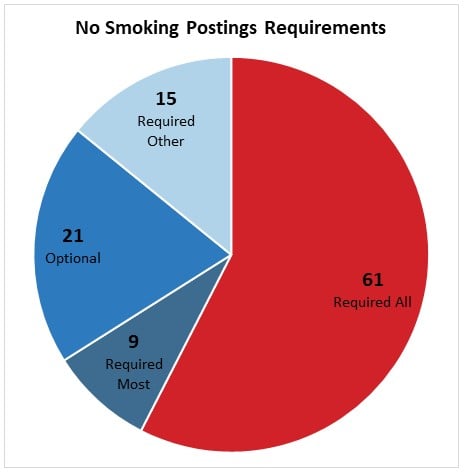
As of June, 2026, GovDocs has 106 No Smoking (or similar) postings active in its offerings. Of those postings, 70 are required for all or most employers, 15 are required for specific types of employers or businesses, and 21 are optional.
Nine postings, including those in Alaska, Greeley, CO, Fort Wayne, IN, Allegheny County, PA, and Dallas, TX, specify a smoke free distance. These distances range from 8 feet (Fort Wayne) to 50 feet (Alaska). Alaska also permits owners or operators of certain fishing vessels or long-term care facilities to determine a reasonable smoke-free distance.
Not all no smoking postings have specific posting instructions. Some generally state that the posting must be “conspicuously posted,” while others specify posting locations. Many of the no smoking postings must be displayed at every entrance.
Jurisdictions with even more specific posting instructions include:
- Alaska No Smoking within 20 feet posting: within 20 feet of an entrance, open window, or heating or ventilation system air intake vent at an enclosed area at a place where smoking is prohibited under the applicable law.
- Sunnyvale, CA No Smoking posting: in every building at each entrance and exit, and at least one other conspicuous place within the buildings.
- Washington, DC No Smoking posting: at the entrance of the building, inside each elevator, and inside the building in sufficient number to give notice to the public.
- Fort Wayne, IN No Smoking – No Vaping within 8 Feet of Entrance posting: Interior and exterior signs are required for all employers. The interior sign must be clearly, sufficiently, and conspicuously posted inside all enclosed spaces where smoking is prohibited. A conspicuous exterior sign clearly stating that smoking is prohibited must be posted at every entrance.
States with no statewide no smoking posting requirements:
- Colorado (local requirements)
- Florida (local requirements)
- Kentucky (local requirements)
- Mississippi
- Nebraska
- South Carolina
- South Dakota
- Texas (local requirements)
- West Virginia
No smoking posting requirements vary widely by jurisdiction in terms of who must post, where the posting must be placed, and how far from an entrance it must appear. Because requirements differ at the state, county, and city level, employers with locations in multiple jurisdictions should confirm the specific requirements for each location rather than applying a one-size-fits-all approach. Employers in states without a statewide requirement should also check for applicable local ordinances before assuming no posting is required.
No smoking postings are included in GovDocs’ Labor Law Poster Program, which tracks active requirements across hundreds of jurisdictions and delivers updates automatically.