EMPLOYMENT LAW NEWS
Virginia Enacts Expanded Paid Sick Leave Law
 By Dana Holle, GovDocs Counsel and Manager Employment Law and Compliance
June 16, 2026
Virginia’s newly signed Senate Bill 199 expands paid sick leave to almost all employers in the state through a phased implementation running from 2027 to 2029. Employers should begin reviewing their existing PTO policies now to ensure compliance before the first deadline takes effect.
On May 20, 2026, Virginia Governor Abigail Spanberger signed Senate Bill 199 (SB 199) into law, creating Virginia’s new paid sick leave program and expanding coverage to almost all employees in the state. As Governor Spanberger stated, “This law will protect workers, strengthen Virginia businesses, and make our Commonwealth a place where people can build the kind of stable, secure lives they deserve.”
Paid Sick Leave Coverage
Prior to the passage of SB 199, Virginia required paid sick leave only for health care workers. Now, SB 199 expands paid sick leave coverage to employees and employers as follows:
- Effective July 1, 2027 – employers with at least fifty employees
- Effective Jan. 1, 2028 – employers with at least twenty-five employees
- Effective Jan. 1, 2029 – employers with at least one employee
Employers include private employers as well as the Commonwealth, including its agencies, institutions, and political subdivisions. Notably, the new paid sick leave program excludes home health workers as they remain covered under their own paid sick leave law.
Accrual, Carryover, and Frontloading
Virginia’s paid sick leave program requires covered employers to provide their covered employees with 1 hour of paid sick leave for every 30 hours worked. Accrual begins at the start of employment. An employer may also loan paid sick leave to an employee in advance of its accrual.
Furthermore, paid sick leave must carry over to the year following the year it was accrued. The max accrual cap and max use per year is 40 hours of paid sick leave unless the employer decides to offer a higher limit. Employers are also allowed to frontload, but they must provide 40 hours of sick leave at the beginning of a year to satisfy their paid sick leave obligations.
Keep Informed
with GovDocs Employment Law News
Eligible Reasons to Use Paid Sick Leave and Covered Family Members
Paid sick leave must be provided for the following reasons:
- An employee’s mental or physical illness, injury, or health condition, including medical diagnosis, care, or treatment, and preventive medical care
- Care for a family member with a mental or physical illness, injury, or health condition, including diagnosis, care, or treatment, and preventive medical care
- Absence due to domestic violence, sexual assault, or stalking-related needs, including medical care, mental health care, counseling, legal services, relocation or securing of an existing home, or other victim services for the employee or the employee’s family member
Virginia also defines “family member” broadly to include:
- Child (including biological, adopted, foster, step, legal ward, or in loco parentis relationships)
- Parent (including biological, adoptive, foster, step, legal guardian, or in loco parentis relationships of an employee or spouse/domestic partner)
- Spouse or domestic partner
- Grandparent, grandchild, or sibling (including biological, adoptive, foster, or step relationship of an employee or employee’s spouse/domestic partner)
- Individual an employee is responsible for providing or arranging health or safety-related care
- Any other individual related by blood or affinity whose close association with an employee is equivalent to a family relationship
Existing PTO Policies
Employers are not required to provide additional paid sick leave if they already offer a paid leave policy, such as a paid time off (PTO) policy, which provides paid leave that meets or exceeds the law’s requirements regarding amount, purposes, and conditions of use.
Likewise, employers covered by a bona fide collective bargaining agreement are not required to provide additional paid sick leave if the agreement provides equivalent paid leave benefits.
Poster, Notice, and Recordkeeping Requirements
SB 199 requires the Commissioner of Labor and Industry to adopt regulations on notice and recordkeeping requirements. According to the legislation, the following will be required:
- Notice – required to be provided to employees in writing
- Poster – required to be displayed in the workplace
- Recordkeeping – required to keep records of paid sick leave use and accrual for three years
Key Takeaways for Employers
With SB 199, Virginia joins the growing list of states expanding paid sick leave protections for employees. Employers should begin reviewing their existing paid time off policies, employee communications, and recordkeeping procedures well in advance of the law’s phased implementation dates to ensure compliance. Organizations with multi-state workforces should also evaluate how Virginia’s new requirements fit within their broader paid sick leave compliance strategy.
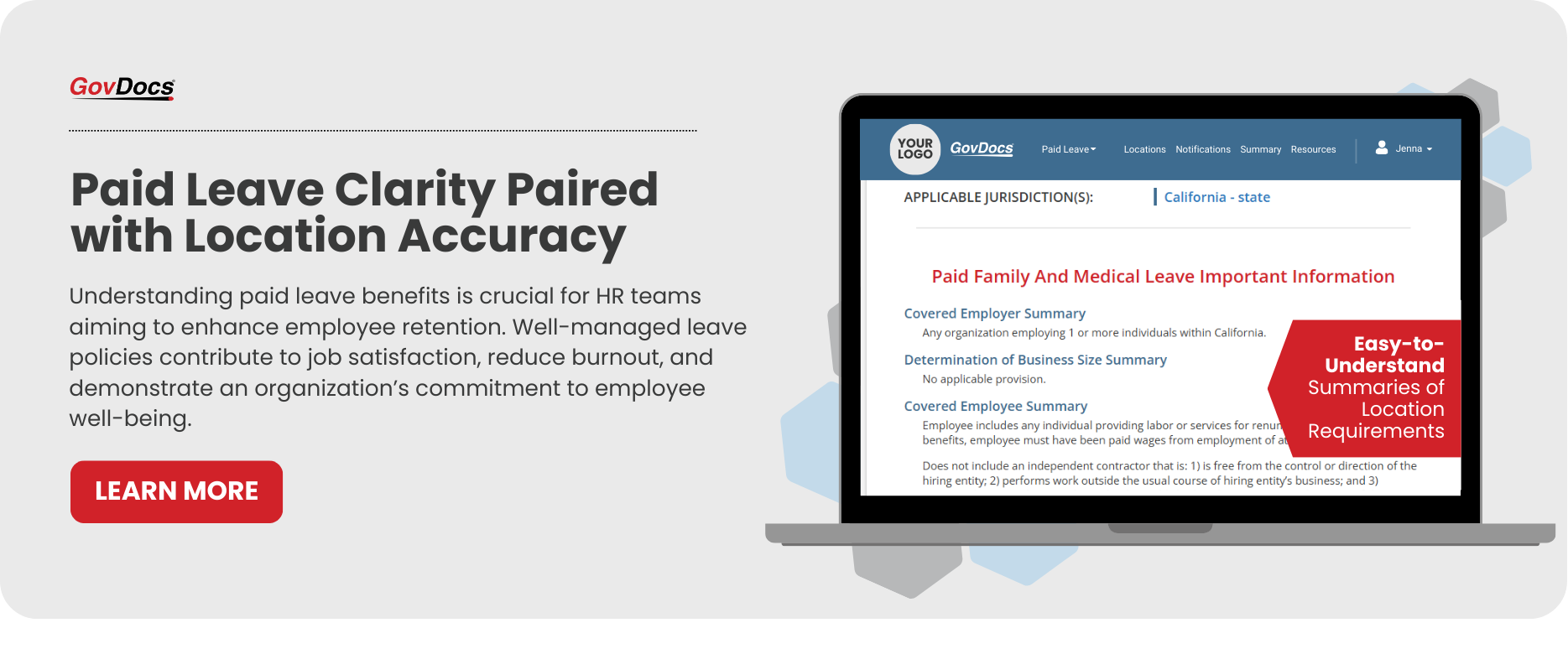
Keeping up with evolving paid leave requirements can be challenging, especially as state and local laws continue to expand. GovDocs’ Paid Leave Solution helps employers stay compliant by tracking and summarizing paid leave requirements across jurisdictions.