The Hidden Compliance Risk in Labor Law Posters:
Address Issues, Missed Shipments, and How to Fix Them
By The GovDocs Team • October 2026

The Hidden Compliance Risk in Labor Law Posters:
By The GovDocs Team • October 2026
Except, if posters never reach the right location, it is not a poster problem, it is an address problem. And an address problem can quickly turn into a compliance problem. For multi location employers, especially across multiple states and jurisdictions, inaccurate or incomplete shipping addresses are one of the most under appreciated risks in labor law poster programs. This is exactly the issue GovDocs Address Validation is designed to solve.
We will walk through why bad addresses create real compliance gaps, how Address Validation works inside the GovDocs platform, and why choosing the recommended USPS address is the most reliable route.
WHERE PROGRAMS BREAK DOWN
If a poster never arrives, employees are not properly notified, and your organization is not fully compliant, even if you placed the order on time.
Labor Law Posters
For multi-location employers, ensuring labor law posters reach every site is a critical compliance task. However, inaccurate or outdated shipping addresses often cause posters to go missing, creating significant legal risks and operational burdens.
Addresses become outdated, are entered inconsistently, or are copied hurriedly from different systems.
Undelivered posters expose your company to audits, fines, and inconsistent employee experiences.
An investigator won't distinguish between "ordered" and "never arrived" during an audit.
Illustrative example
Address validation automatically checks your location data against the official USPS database.
This ensures deliverability, standardizes formats (e.g., "Hwy" vs. "Highway"), and reduces delays.
Spend less time chasing tracking numbers and placing rush orders for missing posters.

Location Addresses are Outdated
Stores move to a new suite, facilities change entrances, buildings get renumbered, and the poster program still ships to the old address.

Internal Spreadsheet are Inconsistent
One team uses “Hwy 7,” another uses “Highway 7,” some include suites, some do not. Small variations add up to delivery issues.

New Locations are Added in a Hurry
An opening date is set, the location needs posters immediately, and an unverified address is copied from an email or lease.

Locations Close without Notice
HR missed the memo that an entire unit or location is not in service and is still active to receive posters.
THE IMPACT
When a poster shipment goes to the wrong place, or cannot be delivered at all, the impact is bigger than a single envelope.
Employees might be working without up-to-date information about their rights, especially when laws change monthly.
Some locations are fully current, others lag behind because their posters are delayed or misdirected.
In an investigation or complaint, regulators will not distinguish between “we ordered the poster” and “the poster never arrived.” They will look at what is posted on the wall.
Teams spend time chasing tracking numbers, calling locations, placing rush orders, and reconciling which sites are still missing materials.
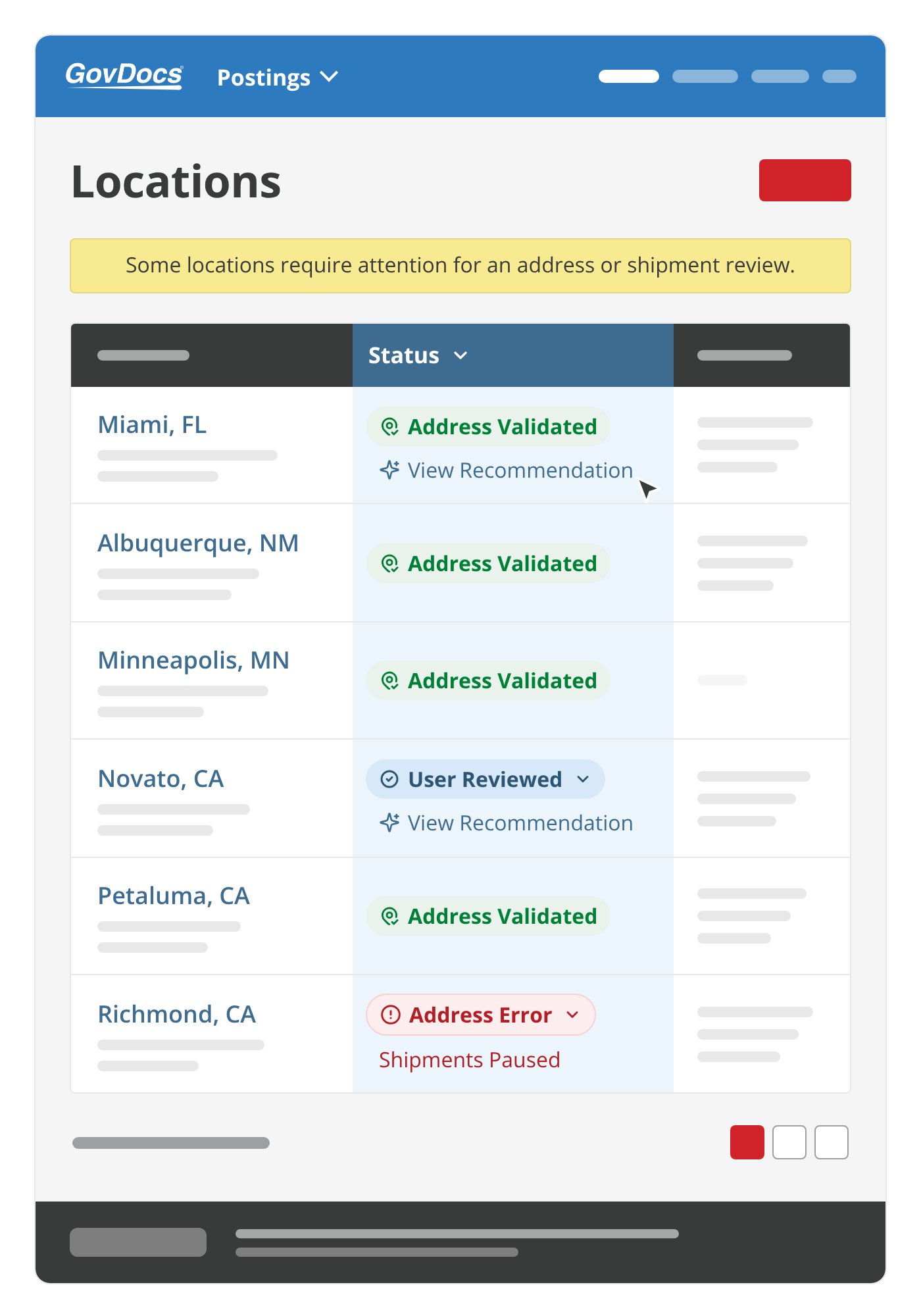
Address Validation in the GovDocs Labor Law Poster Update Program is designed to help you prevent non-compliant locations before they happen. At a high level, here is what it does:
When you onboard, add, or update locations, Address Validation compares those entries against standardized USPS information for deliverable addresses.
Locations with potential issues are highlighted, for example, missing suite numbers, invalid house numbers, outdated street names, or formatting that may cause delivery problems.
For flagged locations, you will see a recommended USPS-formatted version of the address. This is the version USPS recognizes and uses for delivery.
You remain in control. You can confirm the USPS recommendation, adjust the address further, or retain your internal version when necessary.
Once validated, those standardized addresses are used for future poster shipments, reducing the likelihood of missed deliveries and undeliverable packages.
This is one of the key differences between a “ship and hope” model and a truly managed labor law poster program.
If your organization relies on additional third-party carriers such as FedEx or UPS, you’re already in great shape with the new GovDocs Address Validation feature. These carriers follow the same national addressing standards established by the United States Postal Service, meaning their validated addresses align with the standardized format GovDocs uses. As a result, any address successfully verified through FedEx, UPS, or similar services will work seamlessly within GovDocs, for fewer delivery issues and a smoother compliance process overall.
WHY IT MATTERS
A natural question is, “Why should we use the USPS recommended address instead of the version we use internally?” Here is why the USPS recommended address is so important for labor law poster shipments.
Internal addresses are often written for people inside your organization. USPS addresses are formatted for delivery. The recommended USPS address:
This matters because shipping carriers and third-party logistics providers rely heavily on USPS data. If the address does not match what they expect, the chance of a delay or return goes up.
When you adopt the recommended USPS address, you reduce small variations that cause confusion, for example:
Each of these variations may still “make sense” to internal teams. Standardized addressing gives carriers a clear, consistent target for delivery.
Even if your HRIS, payroll, or facilities tools use a slightly different format, using USPS recommended addresses for poster shipments gives you a reliable baseline. Over time, many organizations choose to align their core systems to USPS formatting, which simplifies:
For labor law posters specifically, this alignment means fewer exceptions and special cases in your shipping workflows.
When you approve the recommended USPS address, you are effectively “pre-approving” that location for shipments. That reduces:
In short, the recommended USPS address puts the burden of address accuracy on the postal data, not on busy HR or operations teams.
FAQ
What happens if I ignore the recommended USPS address and keep my version?
You can keep your existing address in the GovDocs platform, however, the risk of delivery issues is higher if the address does not match USPS records. Inconsistent abbreviations, missing suite details, or outdated street names may cause carriers to delay or return shipments. When in doubt, we recommend using the USPS suggestion and incorporating any critical internal details, such as store numbers, in a separate field, not in the street address line.
We use store numbers or location codes in our address fields. Will those be lost?
Store numbers and internal codes are important for your internal reporting, however, they can interfere with delivery if placed in the street address itself. The best practice is to keep the street, city, state, ZIP aligned to the USPS recommended address, while storing store numbers or cost centers in dedicated fields, for example, “Location Name” or “Internal ID.” That way, you preserve internal identifiers and still benefit from standardized shipping addresses.
Our locations are in malls, office parks, or campuses. Will USPS recommended addresses handle suites and units correctly?
Yes, in most cases the USPS recommended address will include suite, unit, or building information in a format that carriers recognize. If the suggestion is missing a suite, or if you know the physical access point differs, you can update the address details before saving. The key is to start with the USPS recommendation, then refine if needed, rather than starting from an unvalidated custom version.
What if our shipping carrier is not USPS? Do USPS addresses still matter?
Even when you use other carriers, many rely on USPS data in the background to validate and standardize addresses. A USPS formatted address is more likely to pass those checks, regardless of the shipping provider. In other words, USPS recommended addresses help your shipments succeed across multiple carriers, not just USPS deliveries.
Can Address Validation fix all address issues automatically?
Address Validation dramatically reduces address related problems, however, some locations still need human review, such as new construction, private campuses, or unique access instructions. In those cases, the system will still flag potential issues and present a recommended address when possible, and your team can confirm or adjust based on local knowledge.
How often should we review our addresses in the GovDocs platform?
A good rhythm for multi location employers is:
Address Validation helps you focus those reviews on locations that truly need attention, rather than manually checking every site.
ADDITIONAL RESOURCES
 https://www.govdocs.com/wp-content/uploads/2026/06/2025-Blog-Feature-Image-Template-12.png
512
1024
Jenna Fuhrman
https://www.govdocs.com/wp-content/uploads/2025/08/GovDocs-Logo-340-x-120-px-1.png
Jenna Fuhrman2026-06-24 13:51:382026-07-27 10:22:41June 2026 Release Roundup
 https://www.govdocs.com/wp-content/uploads/2026/02/2025-Top-Product-Releases-Highlighting-a-Year-of-Innovation-Accuracy-and-the-Realities-of-HR-Compliance.png
512
1024
Jenna Fuhrman
https://www.govdocs.com/wp-content/uploads/2025/08/GovDocs-Logo-340-x-120-px-1.png
Jenna Fuhrman2026-02-17 15:14:482026-03-25 11:01:322025: Top Product Releases Highlighting a Year of Innovation, Accuracy, and the Realities of HR Compliance
 https://www.govdocs.com/wp-content/uploads/2025/12/Release-Roundup-minimum-wage-starting-rates-and-payroll-system-accuracy-4.png
512
1024
Jenna Fuhrman
https://www.govdocs.com/wp-content/uploads/2025/08/GovDocs-Logo-340-x-120-px-1.png
Jenna Fuhrman2025-12-09 14:53:092026-06-21 08:26:07December 2025 Release Roundup

 Federal Contractor Minimum Wage Increase Effective January 6, 2027