AUGUST EDITION
Your Compliance Questions, Answered: Local Minimum Wage Updates in Nebraska, Philadelphia’s New Fair Chance Poster, and Beyond Breakroom Postings
 By Christina Everling, GovDocs Attorney
Employment Law and Compliance
August 25, 2026
Each month, GovDocs’ Employment Law & Compliance Team answers the most common employment law questions employers are facing. This edition covers the ongoing minimum wage dispute between Nebraska and the cities of Lincoln and Omaha, Philadelphia’s updated Fair Chance Hiring poster requirement, and how employers determine where workplace postings need to be displayed beyond the breakroom.
Staying compliant in today’s rapidly evolving employment law landscape often raises more questions than answers. Each month, Christina Everling, GovDocs’ Attorney on the Employment Law & Compliance Team, tackles the most asked employment law compliance questions by employers across the country.
What Minimum Wage Applies in Lincoln and Omaha?
For now, the statewide rates apply in both cities: a $15.00 standard minimum wage, plus a lower $13.50 rate for younger workers. Lincoln and Omaha have each passed ordinances that would eliminate the lower youth rate and change how the wage increases each year, but Lincoln’s ordinance is on hold in court and Omaha’s does not take effect until October 1, 2026. The timeline below explains how the conflict developed and what employers in each city should be tracking.
Keep Informed
with GovDocs Employment Law News
The Recent History of Nebraska’s Minimum Wage Law
In 2022, Nebraska voters passed Statutory Initiative Measure 433 to incrementally increase the state’s standard minimum wage from $9.00 per hour to $15.00 per hour by 2026, and then, starting on January 1, 2027, the minimum wage would be adjusted annually based on the CPI-U. The minimum wage for tipped employees would remain at $2.13 per hour.
Nebraska’s minimum wage increased each year in accordance with Initiative 433 and reached $15.00 on January 1, 2026. However, just a month later, the state’s legislature passed LB 258, which kept the $15.00 minimum wage for 2026, but carved out a lower youth minimum wage of $13.50 for non-emancipated minor employees between the ages of 14 and 16 years old, which would increase 1.5% every 5 years, beginning in 2030. The training wage rate for employees between 16 and 20 years old was updated from 75% of the federal minimum wage to $13.50 with a 1.5% annual increase starting in 2027. LB 258 also replaced the standard annual cost-of-living adjustment with a flat 1.75% annual increase. These changes took effect on July 17, 2026.
Lincoln and Omaha Enact Local Minimum Wage Ordinances
In response to the state’s minimum wage changes, in May, the City of Lincoln adopted Ordinance No. 21872 to restore the uniform $15.00 minimum wage and the CPI-U-based increase schedule, effective July 18, 2026. Nebraska Attorney General Mike Hilgers filed suit against Lincoln in June, arguing that the ordinance is preempted by state law and therefore unconstitutional.
Despite the Lincoln lawsuit, on July 14, 2026, Omaha followed in Lincoln’s footsteps, passing a similar minimum wage ordinance rejecting the youth minimum wage carveout and reinstating the cost-of-living adjustment. Just days later, on July 17, the Lancaster County District Court granted Attorney General Hilgers a temporary injunction, preventing enforcement of Lincoln’s minimum wage ordinance. Regardless of the injunction, Omaha’s mayor still signed Ordinance No. 44716, which is set to take effect on October 1, 2026. On August 18, Attorney General Hilgers filed suit against the City of Omaha seeking to enjoin enforcement of its minimum wage ordinance as unconstitutional. On September 28, 2026, the Douglas County District Court granted Attorney General Hilgers a partial temporary injunction regarding the higher youth minimum wage. Omaha employers may pay youth employees the state’s lower rate of $13.50. The court allowed Omaha’s minimum wage to index based on the CPI-U, rather than the state’s flat 1.75%, starting in January 2027. GovDocs is monitoring for legal updates regarding Omaha and Lincoln minimum wage ordinances.
Nebraska |
Lincoln |
Omaha |
|
Standard Minimum Wage |
$15.00 |
$15.00 |
$15.00 |
Annual Increase |
1.75% |
CPI-U |
CPI-U |
Youth Minimum Wage |
$13.50 |
None ($15.00) |
TEMPORARILY ENJOINED |
Status as of 10/6/2026 |
Effective 7/17/2026 |
TEMPORARILY ENJOINED |
Effective 10/1/2026
|
Tracking Minimum Wage in Lincoln and Omaha
Employers in Lincoln and Omaha should watch this space closely, as the lawsuits’ outcomes will determine which wage rate structure will apply at the local level. Keeping current on each jurisdiction’s rate can be challenging. Luckily, GovDocs Minimum Wage tracks minimum wage changes for all your locations in the United States and Canada. Additionally, employers can stay up to date with the latest employment law developments by subscribing to the GovDocs Employment Law News Blog.
What Fair Chance Posting Do Philadelphia Employers Need to Display?
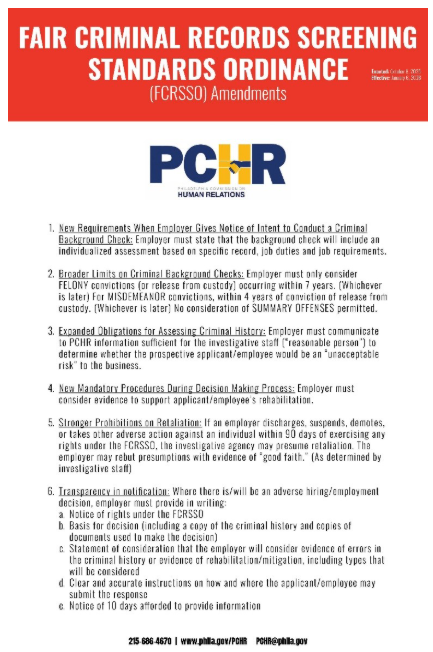
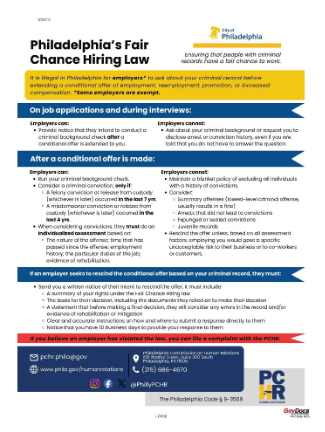
Updates to Philadelphia’s Fair Criminal Record Screening Standards Ordinance (“FCRSSO”) resulting from Bill No. 250373-A went into effect in January 2026. Among the changes made to the FCRSSO, the bill:
- decreased the lookback period for misdemeanor convictions from seven years to four years;
- prohibited employers from considering summary offense convictions;
- expanded notice requirements for adverse actions to cover intent to reject;
- required applicants be given the opportunity to respond to an adverse action before a final decision is made; and
- provided enhanced remedies for violations.
The posting requirement provision remained unchanged, still requiring employers to “post a summary of the Chapter requirements, in a form to be supplied by the Commission, in a conspicuous place on the employer’s website and premises, where Applicants and Employees will be most likely to notice and read it.”
Poster Uncertainty
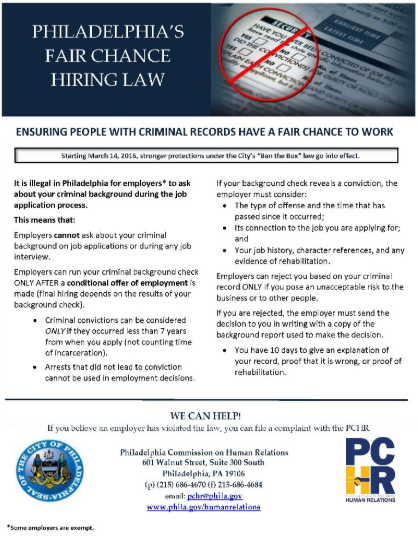
Though the effective date of the bill was in January, the PCHR did not add to or update its Fair Chance Hiring Law poster library until April 2026, when it quietly added “Notice: 2026 amendments to Fair Chance Hiring Law.” Prior versions of Fair Chance posters from 2021 and 2024 remained available, leaving it unclear whether this “Notice” satisfies the posting requirement in the FCRSSO. GovDocs contacted the PCHR for clarification, and the PCHR confirmed that the Notice is not the poster required to be displayed under the FCRSSO.
Name |
Released |
Notice: 2026 amendments to Fair Chance Hiring Law |
April 28, 2026 |
Fair Chance Hiring law poster |
April 23, 2021 |
Fair Chance Poster – English/Spanish |
March 26, 2024 |
The New Fair Chance Poster
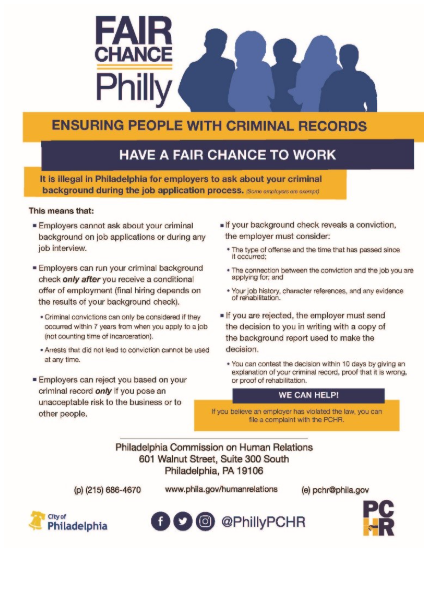
Then, in July, the PCHR released the updated Fair Chance Hiring poster in English. GovDocs has followed up with the PCHR to determine whether the PCHR will release a Spanish version of this poster and is awaiting a response. The updated Fair Chance posting will be shipped to impacted GovDocs Standard Update Program customers in September. Employers should discard old Fair Chance postings and display the new one.
X 2021 Poster
X 2024 Poster
X 2026 Notice
2026 Poster
Are Any Workplace Postings Required Beyond the Breakroom?
Workplace posters are required to be displayed in conspicuous places frequented by employees in the workplace. Well-trafficked employee areas include lunchrooms, breakrooms, main hallways, conference spaces, employee lounges, and kitchens. However, some postings have specific location requirements outside of these areas, based on the posting’s target audience.
Applicant-Facing Postings
There are certain labor law postings that must be displayed for job applicants, including some federal posters. Interviewees generally never enter employee breakrooms or other common areas where labor law posters are displayed, and while they do not need access to all state and local applicant postings, they do need access to the ones in the jurisdiction in which they are applying for a job.
Employers can meet the posting requirements for applicant-facing postings in multiple ways:
(1) If the applicant is coming into the building, the postings must be displayed in a conspicuous place where applicants for employment can see them.
(2) If the applicant is virtual, employers can satisfy the posting requirements by providing the postings to applicants electronically or by hosting the postings on an internal portal that applicants can see during the application process.
Fair Housing Postings
Similar to applicant-facing postings, fair housing postings must be displayed where prospective tenants, buyers, or borrowers will see them. For example, real estate brokers and businesses involved in making or purchasing loans or providing financial assistance for real estate purchases must display any required fair housing postings where transactions occur and at any site listed for sale or rental.
No Smoking Postings
No Smoking postings must often be displayed at entrances, but some have additional location requirements. For example, the Sunnyvale, CA No Smoking posting must be displayed at every building’s entrances and exits, and at least one other conspicuous place within each building (e.g., the breakroom).
Human Trafficking Postings
The target audience for the information included on human trafficking postings are potential victims, so posting requirements often include places where a potential victim might be alone and able to read the information. For example, in Georgia, certain types of employers are required to display human trafficking postings in each public restroom and in a prominent location at the business’s entrance.
Placement Matters as Much as the Posting
When displaying workplace postings, rather than defaulting to the breakroom, employers should check posting requirements to determine the audience and verify whether there are specific placement requirements. Tracking both compliance and placement across every location is easier with a program built to handle both. GovDocs’ Labor Law Poster Program keeps your postings current so you know what to display and where.